Showing posts with label #Portugal. Show all posts

Thursday, November 24, 2022

Braga and Guimarães a lesson in religious history


Braga


The city of Braga is over 2000 years old and after the Moors were reconquered, the first Roman Archbishop Dom Pedro was installed and a new cathedral was built.  Braga is still a religious center of importance in Portugal to this day and many holy days are still celebrated in the city. The University of Minho has brought many students and boasts one of Portugals youngest populations.


Braga Cathedral was built in the 9th century under the first Bishop Dom Pedro and is Portugal's oldest cathedral. The structure is a mixture of Baroque and Gothic architure.


The original Porta Nova Arch in the city square was built in 1512 as a city gate, but this one is from the 18th century.


The Santa Barbara Gardens (Jardim de Santa Barbara) surround the city square and mix the flowers and fountains.


The Sanctuary of Bom Jesus do Monte


High above the city is the Sanctuary of Bom Jesus do Monte, an impressive neoclassical church  surrounded by imposing sculptures of the Passion of Christ. Walk, drive or take the lift to the church in the sky.


View of Braga from Sanctuary


Inside Sanctuary

Passion of Christ sculptures


Guimarães 


Known as the “Cradle City,” Guimarães is the home to the first royal king, Dom Alonso Henriques and is now a World Heritage Site.


The castle and chapel of São Miguel was built by Countess Mumadona Dias in the 10th century as a way to keep out the Moors and Normans (protecting the Christians community) and is the birthplace of the first king of Portugal, Dom Alonso Henriques.


Manor House built in 15th century

Castle Chapel


The manor house is now a museum and hosts various events.


View of Guimarães from atop the castle battlements


In the town, Largo da Oliviera square houses the remains of the Oliviera church and cloister and is a museum.


The Church of Santos Passos commands the city centre

The Church of Santos Passos completed in 1785, is baroque style architecture (many cities in Portugal are a mix of Baroque, Gothic and Roman influenced architecture).

In other news...

I spoke with Gail at Relocate to Portugal and got the skinny on what I need to do moving forward for a Visa. She was very helpful and I think I may contract with her now even though I wouldn’t be looking to move right away. Actually I’m looking forward to see Charlotte and not living out of a suitcase for a while.


Reflecting on what I’ve learning about Portugal:

1. It rains a lot in winter and summer is pretty dry and warm

2. Francesinha is not a dessert, but a disgusting meat dish 

3. I love octopus

4. The Portuguese put an egg on top of everything

5. oPorto Tonica is my new favorite drink

6. It was fairly easy to communicate even if someone didn’t speak English. The Portuguese people do try and figure out what you are saying.

7. Wine is not only inexpensive, it is good!

8. The countryside is beautiful

9. The public transport in the cities is exceptional

10. If I do decide to live in Portugal, Porto is the place


Tuesday, November 8, 2022

Douro Valley Wine Tour and WOW Workshop


Wine Tour


We started off the wine tour in the Vinho Verde (Green wine) area of Portugal, with a visit to Amarante. Amarante is best known for the Peninsula War battle between Portuguese and French troops and is a lovely little village on the bank of the Rio Tâmega.


Amarante is also on the famous Mass of the Pilgrims stop from Porto to the Cathedral of Santiago de Compostela. You can tell by the shells imbedded on the ground.


Church of São Gonçalo still shows damage from the war. 


As we head from the Vinho Verde region into the Douro Valley region the highway is lined with vineyards and olive trees. We went to three different wineries and tried many different types of port. 


The first winery was the best. Port wine is not my favorite wine, but I will admit that the port we tried at this winery was quite good. This winery is over 100 years old and the owner showed us a bottle of port worth more that $4000 (we didnt taste that one though).


Fun Fact: Not all port is dark or rose colored, white port is quite delicious with tonic water and called Porto Tónico (but can be made with Rose port too).


Many vineyards are separated by olive trees instead of walls. Also, many of the vineyards don't use machinery (they terraces are too narrow) so the grapes are all hand picked. Usually during the late summer when it is really hot in the valley.


Terraced vineyards along the Douro River


Fun Fact: There are three different varieties of olive oil from Portugal and some vineyards will separate their vine varieties with olive trees instead of walls.


World of Wine School (Portuguese wines)


The workshop was over 2 hours and focused on 5 of the 11 wine regions of Portugal. 


My table ready for tasting


By the numbers: Portugal is 11th in the world for wine production (60% of all Port wines come from Portugal), 9th in world export of wine, 4th in Europe and 11th in world wine consumption (inexpensive wine).

Fun Fact: 80% of all cork used in the world comes from Portugal. I’ve not seen one bottle of wine with a screw top, all had corks. And...not just for wine corks, but anything that has cork in it!


Wines in order of the tasting

First region and first taste (after the lovely Rose welcome wine we had), is from Vinho Verde. Green usually means young wine, but not in this instance, it means it comes from a very green area of north Portugal which is colder making the wine more acidic. The taste was dry and aromatic with a long finish.


Climate: Atlantic; Soil, Granitic; #of Vines 24,000


Second taste was from the Baixo region near the border of Spain and Corgo River. This area is completely dependent on rain as it cannot be irrigated due to it being a UNESCO site. It was a red wine blended with 30 varietals, tasted of plum and dark cherry.

Climate: Mediterranean/Continental (hot, hot, hot 45c/113f in the summer); Soil, Black Slate; #of Vines 44,000

The third tasting was from the Dão region, one of the oldest established regions in Portugal. High altitude and sun exposure and very windy area. A white wine that was voted party wine of 2021, smelled to me like a Sauvignon blanc but the finish was more like a Viognier.

Climate: Mediterranean; Soil, Granitic; #of Vines 20,000


Fun fact: The vineyard owners in the Dão region plant roses around the vines so the “critters” will eat the roses first before the vines.


Bairrade is the fourth region with a spicy, blended wine that’s complex. It’s good with meat (especially pork). You really need food with this wine. It was good, but not my favorite. The region is coastal, lower altitude.


Climate: Moderate Atlantic; Soil, Limestone clay; #of Vines 13,000


The fifth region, Alentejo is referred to as “the bread basket of the country”. Very flat area producing mainly full-body red wine with more oxidation and a sour cherry or black fruit finish. The white wine from this area is aged in oak for 12-24 months and bottled for at least 3 years before sold. We had a white Antão Vaz grape wine. It was very, very good.

Climate: Continental (cold winters, hot summers); Soil, Granitic; #of Vines 25,000


How to taste wine


I'm certified!


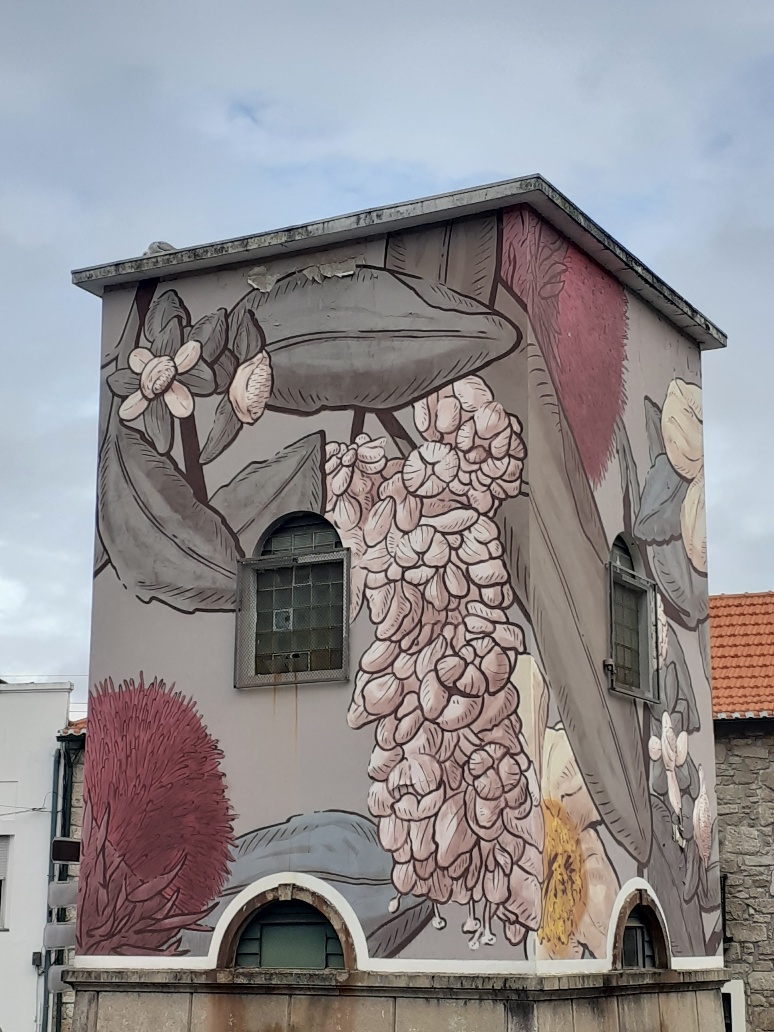
Here's some street art I thought was interesting in Gaia right near the World of Wine


In other news...

I've rented an apartment in Charlotte, NC for six months starting in December. I should get the paperwork tomorrow so hopefully it will be done soon and I can take a breath. Now I can concentrate on my next adventure to Valencia, Spain this weekend!


Friday, November 4, 2022

Boavista; music, shops, history and nature

SuBenShi Sushi Mural
 

Boavista

Ave of Boavista is Porto’s longest street with hotels, restaurants and shopping. It is really where old meets the new and boasts the famous Casa da Música (house of music) at one end and at the other Jardins do Palácio de Cristal (the gardens of the Cristal Palace).


Monument to the Peninsular War pays tribute to Porto residents who fought to expel Napoleon. Set on top of the monument is a lion representing the Portuguese victory over the French symbol the eagle.


Casa da Música 


Casa da Música was built as part of the European Capital of Culture event in 2001but wasn’t finished until 2005 as is the center of musical performances in Porto. It’s been described as “crazy and perverse, but brilliant” as one of the five architectural projects of the decade.

Museu Judaico (Jewish Museum)


In a city surrounded by Christian churches, here is one of the only synagogues and Jewish museums. Jews had been officially banished from Porto in 1496. The Jewish community of Porto was founded in 1923 and was responsible for the recently opened museum.


Jardins do Palácio de Cristal (the gardens of the Cristal Palace)


The structure was originally modeled on the Crystal Palace in London but was demolished and the Rosa Mota Pavilion (in honor of the Olympic Marathon Champion) replaced it and now houses artistic exhibitions.


Garden of Feelings has a fantastic view of the Douro River.


Rooster with his hens


In other news…

When I leave Portugal on Nov 30, I’ll pass through Boston for a couple of days and then I've booked a trip to Charlotte, North Carolina to see if I can find an apt through the winter. I’ve already applied for a one bedroom apt, so we’ll see if I get it. Stay tuned!